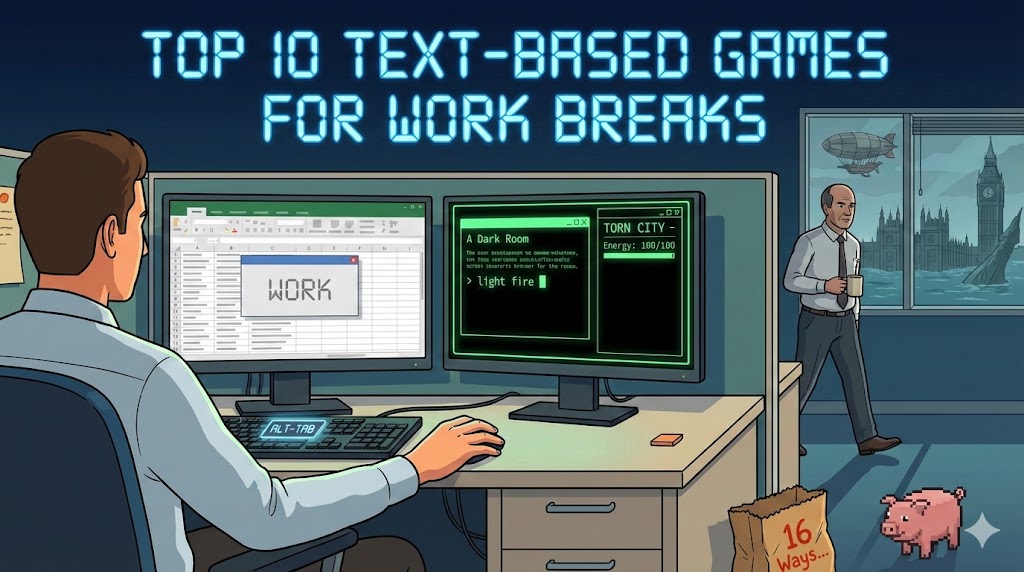
It is 2:30 PM. The lunch rush has faded, the coffee is wearing off, and the spreadsheet in front of you has started to blur into a meaningless grid of grey and white. You are in the midst of the afternoon slump. You need a break, but you cannot exactly fire up a high-definition battle royale shooter on your dual-monitor office setup without attracting the ire of your manager.
You need something subtle. You need something engaging. You need something that looks suspiciously like work.
Enter the world of text-based games. Also known as Interactive Fiction (IF), these games rely on the written word rather than flashy graphics card-melting visuals. They are the ultimate “stealth” gaming option for the busy professional. They run in simple browser windows, often feature monochromatic color schemes that blend in with document editors, and stimulate the imagination in a way that doom-scrolling social media never will.
If you are looking to reclaim your sanity in fifteen-minute increments, we have curated the ultimate list of text-based adventures. From nostalgic dungeon crawlers to modern narrative masterpieces, here are the top 10 text-based games to play during your work break.
What is Interactive Fiction?
Before we dive into the list, a quick primer for the uninitiated. Interactive Fiction generally falls into two categories:
1. Parser Games: These are the old-school style where you type commands into a prompt. You read a description (“You are in a dark room. There is a door to the north.”) and you type what you want to do (“Open door” or “Go north”).
2. Choice-Based Games: These function more like digital “Choose Your Own Adventure” books. You read a chunk of text and click one of several hyperlinks to decide what happens next.
Both styles are perfect for the office environment. They require reading and critical thinking, which means to an outside observer, you just look like you are deeply focused on a very important, text-heavy report.
The Criteria: How We Ranked These Games
To make this list, a game had to pass three specific tests:
-
The Coffee Break Test: Can you make meaningful progress or have a complete experience in 10 to 15 minutes?
-
The Stealth Factor: How conspicuous is the interface? Does it look like a game, or could it pass for a system utility or a Word document?
-
The Engagement Level: Does it offer a genuine mental reset from corporate drudgery?
With that in mind, here are the winners.
1. A Dark Room
Genre: Incremental RPG / Strategy Play Style: Click-based / Passive
If you play only one game on this list, make it A Dark Room. It is the gold standard for browser-based stealth gaming. When you first load the page, you are greeted with a stark white screen, black text, and a single button: “light fire.”
It looks incredibly boring, which is its greatest strength in an office setting. It looks like a glitched settings menu. However, once you click that button, a story begins to unfold. What starts as a simple resource management clicker (gathering wood, stoking the fire) slowly expands into a village management simulator, and eventually, a full-blown exploration RPG with a map, combat, and a surprisingly deep sci-fi narrative.
Why It fits The Work Break: The pacing is perfect for multitasking. In the early stages, you can let the game run in a background tab, checking in every few minutes to gather resources. As the game evolves, it demands more attention, but it never punishes you for looking away to answer an email. It is a slow burn that will keep you occupied for days.
2. 80 Days
Genre: Steampunk Adventure / Strategy Play Style: Choice-Based / Visual Novel
Based on Jules Verne’s classic novel Around the World in Eighty Days, this game puts you in the shoes of the loyal valet, Passepartout. Your job is to guide your employer, Phileas Fogg, around the globe. You manage finances, pack suitcases, negotiate with train conductors, and choose the routes.
The writing in 80 Days is nothing short of spectacular. It reimagines the year 1872 with steampunk flair—think automaton camels and underwater trains. The game is massive, with hundreds of thousands of words of dialogue, ensuring that no two playthroughs are ever the same.
Why It Fits The Work Break: The game is naturally segmented into travel legs. A journey from Paris to Munich might take just a few minutes of real-time reading and decision-making. You can easily play through one city or one travel route during a break, save your progress, and close the tab. It provides a wonderful sense of escapism; for ten minutes, you aren’t in a cubicle— you are on an airship over the Indian Ocean.
3. Torn City
Genre: Text-Based MMORPG Play Style: Long-term Strategy / Social
If you are looking for something that lasts longer than a quick narrative, Torn City is a behemoth. It is a gritty, text-based Massively Multiplayer Online Role-Playing Game (MMORPG) set in a crime-ridden metropolis. You start as a lowly street thug and can work your way up to become a business owner, a stock market mogul, or a feared faction leader.
Unlike graphical MMOs like World of Warcraft, Torn City is played entirely through text menus and static images. It involves training stats in the gym, committing crimes for experience, and managing your education.
Why It Fits The Work Break: Torn City is a marathon, not a sprint. The game operates on real-time timers. You might spend all your “energy” training your defense stat, which takes thirty seconds of clicking, but then you have to wait a few hours for that energy to refill. This makes it the perfect “boss key” game. You log in, spend your energy, check your stocks, and log out. It respects your time while giving you a long-term sense of progression.
4. Lost Pig
Genre: Comedy / Puzzle Play Style: Classic Parser (Typing)
Sometimes, work is stressful. Deadlines loom, clients complain, and printers jam. When the stress levels hit the red zone, you need Lost Pig. This is a classic parser game where you play as Grunk, an orc who—as the title suggests—has lost a pig.
The brilliance of Lost Pig lies in the writing. Grunk is not a smart orc. When you type commands, the game’s narrator responds through the filter of Grunk’s limited intelligence. If you try to examine an object Grunk doesn’t understand, the game explains his confusion in hilarious detail.
Why It Fits The Work Break: It is short, contained, and incredibly funny. The puzzles are logical but satisfying, and the low stakes make it a relaxing experience. It acts as a palate cleanser for the brain. Reading Grunk’s internal monologue is guaranteed to lower your blood pressure better than a stress ball.
5. Photopia
Genre: Narrative / Interactive Story Play Style: Parser (Typing)
Warning: This game might make you cry at your desk. Photopia is legendary in the interactive fiction community, not for its difficult puzzles (it has almost none), but for its storytelling structure. It weaves together multiple seemingly unrelated vignettes involving color, memory, and space travel.
It is difficult to describe the plot without spoiling the experience, but suffice it to say, it is an artistic achievement that utilizes the medium of text games to do things a movie or book couldn’t do.
Why It Fits The Work Break: Photopia is relatively short—you can complete the whole experience in about an hour. It is perfect for a lunch break where you want to engage with something deeper than a casual mobile game. It is a reminder that text on a screen can be powerful art, which might even give you a new appreciation for the words you are typing in your daily reports.
6. Suveh Nux
Genre: Puzzle / Magic Play Style: One-Room Parser
For those who love logic puzzles and “Escape Room” scenarios, Suveh Nux is a hidden gem. You play as a magician’s apprentice who has accidentally trapped themselves in a master’s vault. To escape, you must learn to control the magical properties of the room.
The core mechanic involves learning a fictional magical language. You have to experiment with words to understand how they manipulate objects in the room. It is a game about linguistics and logic rather than inventory management.
Why It Fits The Work Break: The entire game takes place in a single room. You do not need to draw a complex map on a sticky note to remember where you are. The feedback loop of testing a magic spell, seeing the result, and adjusting your theory is incredibly satisfying and stimulates the problem-solving centers of the brain—essentially warming you up for your actual work.
7. Violet
Genre: Slice of Life / Comedy Play Style: Parser
There is a delicious irony in playing Violet at work. The entire premise of the game is procrastination. You play a graduate student trying to write a thousand words of your dissertation. Your girlfriend, Violet, has threatened to leave you if you do not finish it.
The gameplay involves you sitting in a single room, trying to write, while being distracted by everything around you—the window, a puzzle, your own thoughts. You have to “fix” the distractions to get into the zone.
Why It Fits The Work Break: It is a meta-commentary on focus. The writing is witty and relatable for anyone who has ever struggled to meet a deadline. It is a short, single-session game that is charming and, strangely enough, might actually inspire you to close the game tab and finish your own work once you beat it.
8. Fallen London
Genre: Gothic Horror / RPG Play Style: Choice-Based Browser Game
Welcome to a version of London that was stolen by bats and dragged a mile underground. Fallen London is a massive, narrative-rich browser game created by Failbetter Games. It is a world of dark humor, Victorian etiquette, and Lovecraftian horrors.
You create a character and build your stats (Watchful, Shadowy, Dangerous, and Persuasive) by navigating stories. You might investigate a murder at the university, romance a devil, or write poetry for the Empress.
Why It Fits The Work Break: Like Torn City, Fallen London uses an “Action Candle” mechanic. You have a pool of actions (usually 20 or 40) that recharge over time. A typical session involves logging in, reading through some delightful prose, making ten to twenty clicks to advance your story, and then logging out when your candle burns down. It fits perfectly into a fifteen-minute slot and offers some of the best world-building in gaming history.
9. The Dreamhold
Genre: Tutorial / Fantasy Play Style: Parser
If you are a “Casual Gamer” or a “Busy Professional” who has never typed “Go North” into a command prompt, The Dreamhold is your starting point. It was designed specifically as a tutorial for Interactive Fiction.
The game features a “tutorial voice” that gently guides you, explaining how the parser works and offering hints if you get stuck. However, it is not just a dry lesson; it is a fully realized fantasy adventure where you explore a wizard’s high tower.
Why It Fits The Work Break: It is frustration-free. Many older text adventures are notoriously difficult and unfair. The Dreamhold is designed to be smooth and welcoming. It is the perfect entry point to test if this genre is right for you without the risk of rage-quitting during office hours.
10. 16 Ways to Kill a Vampire at McDonalds
Genre: Humor / Horror Play Style: Choice-Based
The title tells you everything you need to know. This is not a deep RPG. This is not a tear-jerking narrative. This is a quick, absurd, and hilarious game about a vampire hunter trying to do their job in a fast-food establishment.
It functions as a checklist. Can you find all sixteen distinct endings? The solutions range from the logical (using a wooden stake) to the ridiculous (using fast-food specific items).
Why It Fits The Work Break: It is the ultimate “micro-break” game. A single run-through might take two minutes. You can hunt for one or two endings while waiting for a file to download or a conference call to start. It requires zero mental load and delivers instant gratification and chuckles.
Tips for Playing “Under the Radar”
While these games are text-based, you still need to be smart about how you play them in an open-plan office. Here are a few pro-tips for the stealth gamer:
Master the Alt-Tab Reflex: Muscle memory is key. Keep your work email or a complex spreadsheet open in a separate window. Practice the “Alt-Tab” (or Command-Tab on Mac) shortcut so you can swap screens the second you hear footsteps approaching.
Use “Incognito” or Text-Only Browsers: Some of these games save progress via cookies, but others don’t. If you are on a shared computer, use Incognito mode to ensure you don’t leave a history trail. For the ultimate stealth, look into text-only web browsers (like Lynx) which make the game look exactly like a command-line terminal for coding.
Mute Your Audio: It sounds obvious, but many modern text adventures include atmospheric sound effects or ambient music. There is nothing more embarrassing than opening a silent-looking text window only to have a dramatic orchestral score blast through your speakers. Always check the volume icon on the browser tab.
The “Note Taking” Camouflage: Many parser games require you to remember names or solve riddles. Keep a physical notepad and pen on your desk. When you are scribbling down “Key is under the rug,” to an observer, you look like you are brainstorming important project ideas.
Benefits of Text Gaming for Professional Brains
Is playing games at work “time theft”? We prefer to call it “cognitive maintenance.” Unlike scrolling through video feeds or social media, which are passive activities that tend to numb the brain, text-based games are active.
They Boost Literacy and Focus: You are reading. You are analyzing text. You are typing. These activities keep your brain in “work mode” mechanics-wise, even if the content is fiction.
Problem Solving: Games like Suveh Nux or Lost Pig require lateral thinking and logic. They act as mental calisthenics, waking up the parts of your brain needed for complex problem-solving in your actual job.
Stress Reduction: The “narrative transport” provided by a good story is a proven stress reliever. Stepping into Fallen London for ten minutes allows you to disengage from workplace anxiety and return to your tasks with a fresher perspective.
Conclusion
Work doesn’t have to be an endless slog of emails and meetings. With the right tools—and a bit of discretion—you can turn your daily downtime into an adventure. Whether you are managing a criminal empire in Torn City or shedding a tear over Photopia, these text-based games offer a perfect escape that hides in plain sight.
So, go ahead. Open a new tab. We won’t tell your boss.
Which of these are you booting up on your next coffee break? Let us know if you found all 16 ways to dispatch that vampire, or tell us if we missed your favorite text adventure.
Leave a Reply